Tungsten is one of those metals everyone agrees is critical — aerospace, defense, cutting tools, electronics — but almost nobody outside the mining world thinks about how difficult it can be to recover from an orebody into a saleable concentrate. I've worked on tungsten projects from Namibia to northern Spain to Myanmar, and if there's one thing I've learned, it's this: tungsten ores are getting harder, not easier. Grades are dropping, grain sizes are getting finer, and the gangue mineralogy is getting more challenging. If you're evaluating a tungsten project or trying to fix an underperforming plant, this is the stuff you actually need to know.
At Xinhai, we see the same principle across tungsten projects: there is no standard flow sheet that works equally well for every orebody. Mineralogical characterization, laboratory testing and process design have to come before equipment selection. The equipment is only as effective as the process it is built into.
Use the table of contents below to navigate through the guide:
01Start with the Ore: Scheelite vs Wolframite
Type | Mineral | Formula | Typical Deposit Style | What works |
Wolframite-type | Wolframite (Fe,Mn)WO₄ | Ferberite to huebnerite solid solution | Quartz veins, stockworks, granite-related | Gravity + magnetic separation |
Scheelite-type | Scheelite | CaWO₄ | Skarns, stratabound, porphyry | Gravity + flotation |
Mixed | Both, often with Sn, Mo, Bi, F | — | Complex hydrothermal systems | Combined gravity + magnetic + flotation |
Here's the thing — wolframite and scheelite might as well be different commodities. Wolframite has a density of about 7.1–7.9 g/cm³, roughly 2.7 to 3 times that of quartz gangue. It is also weakly magnetic. That makes gravity separation, using equipment such as jigs and shaking tables, a natural first choice, followed by magnetic cleaning. Scheelite, on the other hand, has a density of about 5.9–6.1 g/cm³ — not much higher than some common gangue minerals — and is non-magnetic. But it responds well to flotation. So you generally take the flotation route.
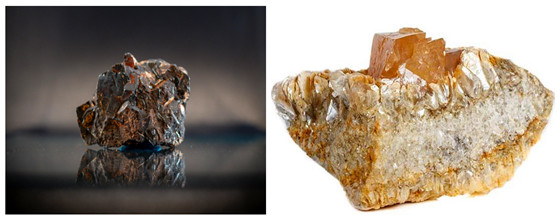
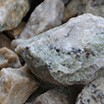
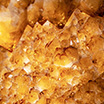
Wolframite (left) vs. scheelite (right)
This is also why, in Xinhai's engineering practice, ore characterization comes before process selection. The mineral species, liberation characteristics, grain size distribution and associated gangue minerals determine what the plant actually needs to separate.
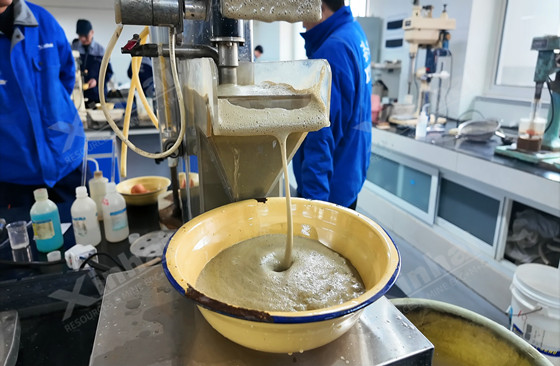
(Tungsten ore beneficiation test work)
02Wolframite: Gravity and Magnetic Separation as Important Methods
Wolframite is brittle. Very brittle. Hit it too hard in the mill and you'll generate large amounts of slimes — and once tungsten reports to the slime fraction, recovery becomes much more difficult. Recovery of particles below 20 μm in conventional gravity circuits typically sits below 45%. That's not simply a flow sheet problem; at this size range, the physical separation becomes much more challenging.
The classic approach, and it still works when done right:
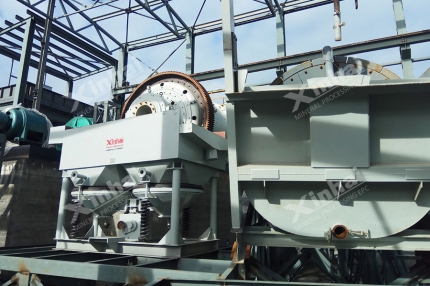
Coarse fraction (1–10 mm): Jigs. Pulsed water and density stratification help recover coarse wolframite early. "Recover it as soon as it's free" — that's the rule.
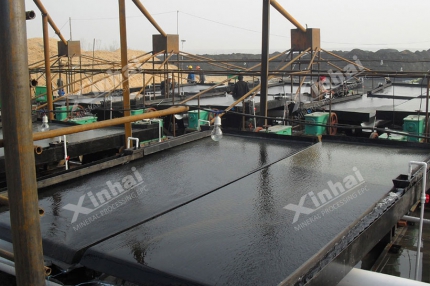
Medium-fine fraction (0.074–2 mm): Shaking tables. High enrichment ratios; you can pull a saleable concentrate directly from the table if the gangue is clean.
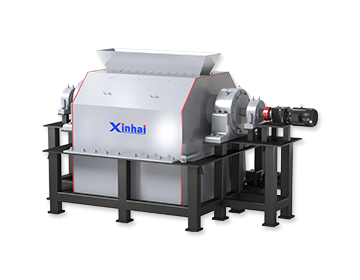
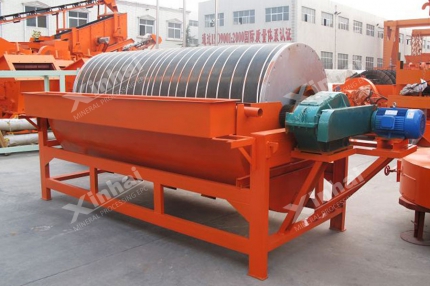
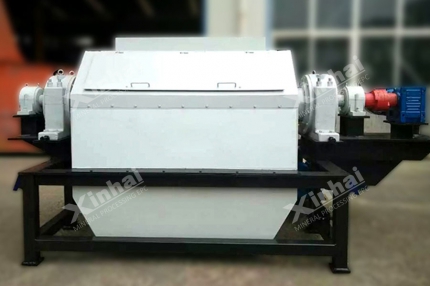
Cleaning: Dry high-intensity magnetic separation. This is where you separate wolframite from cassiterite (tin ore), which has a similar density but is essentially non-magnetic. Old-school three-disk separators still work, but modern rare-earth roll separators and high-gradient magnetic separators can provide more efficient and selective separation.
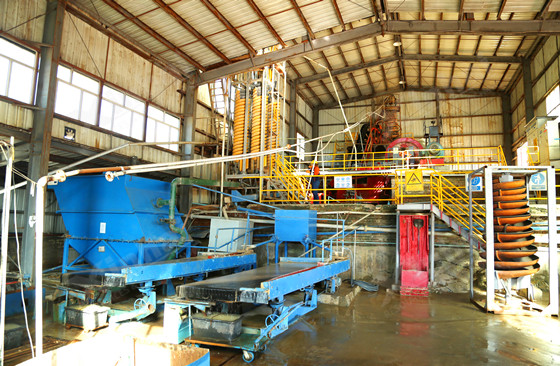
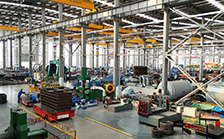
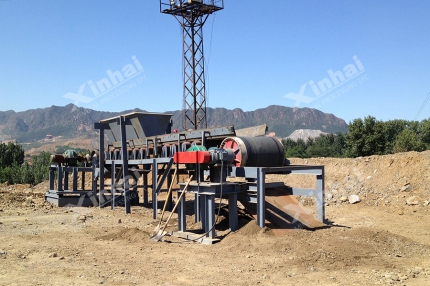
(Tungsten gravity concentration plant)
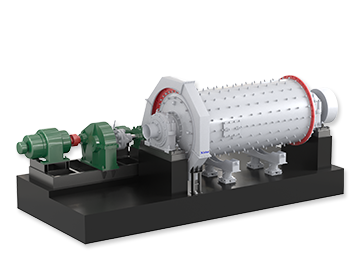
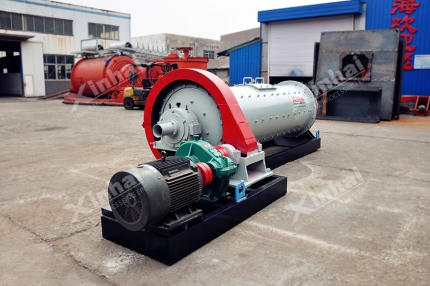
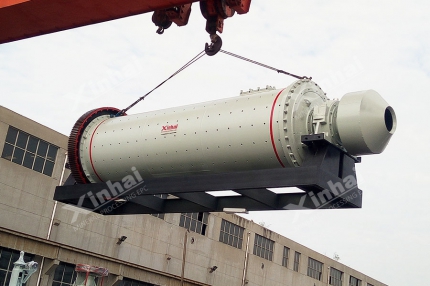
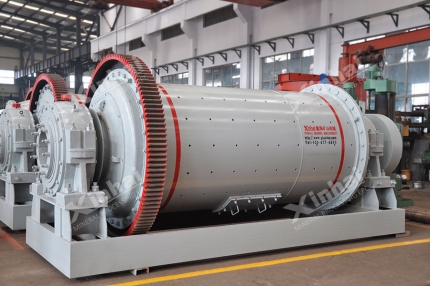
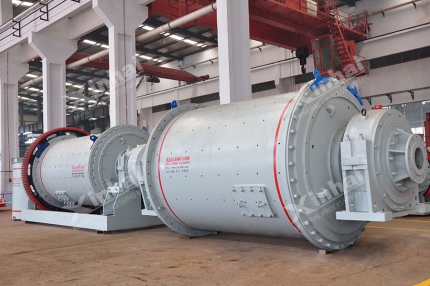
Grinding — this matters more than people admit. Use a rod mill for primary grinding, not a ball mill. The line contact in a rod mill can be gentler on friable minerals like wolframite. I've seen the switch from ball to rod mill alone lift gravity recovery by 10–15% just by reducing over-grinding. That's free metal.
Stage grinding, stage separation. Don't try to mill everything to liberation in one pass. Free particles should be pulled out at the coarsest practical cut size and sent straight to cleaning. Middlings get reground. Slimes get their own circuit.
For a plant designer, this is where the principle of “recover early, grind selectively” becomes important. Rather than treating grinding and separation as isolated steps, the circuit should be designed around liberation and recovery at each stage.
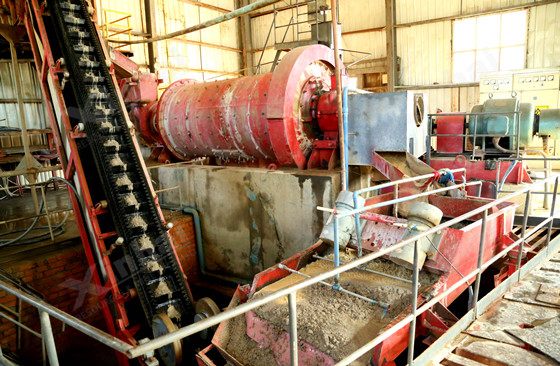
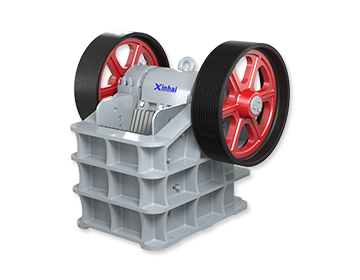
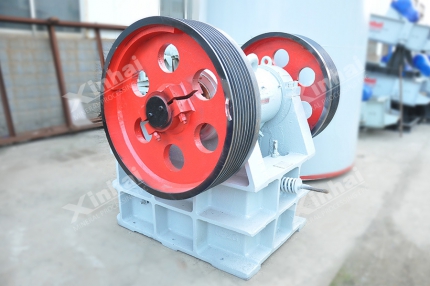
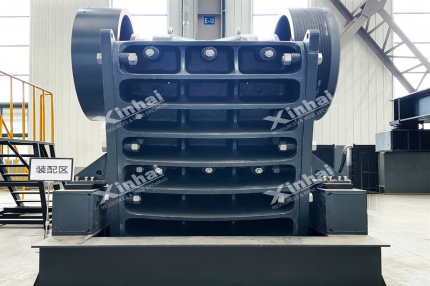
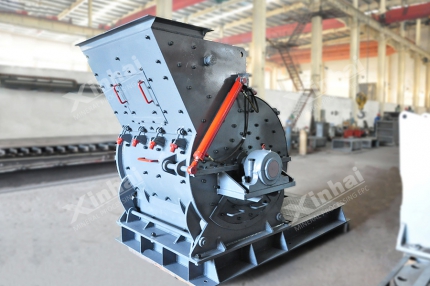
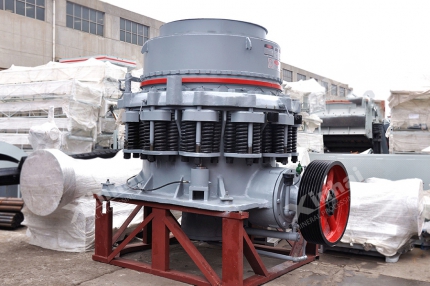
(Tungsten crushing and grinding circuit)
03Scheelite Processing: Flotation Is Important, but Selectivity Is the Real Challenge
If one of the key issues in wolframite processing is making full use of density and magnetic differences, the central issue in scheelite processing is often:
Selectivity.
Scheelite commonly occurs with calcium-bearing minerals such as calcite, fluorite, and apatite.
These minerals can have similar surface chemical characteristics and similar interactions with flotation reagents. As a result, selective separation of scheelite from calcium-bearing gangue can be difficult.
This is why the reagent regime is so important in scheelite flotation.
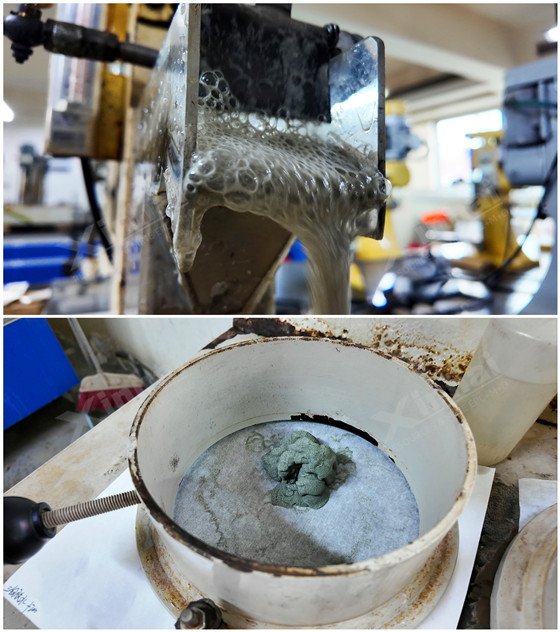
(Mo-W ore test work, Xinhai project)
1. Heated Flotation
Heated flotation is a representative approach used in scheelite flotation.
The basic idea is to use conditioning, reagent addition, heating, and flotation to modify the interaction conditions at the mineral surface and improve separation selectivity between scheelite and gangue.
However:
Heated flotation is not required for every scheelite ore.
The appropriate temperature, pulp density, reagent regime, and cleaning conditions should be determined according to the ore characteristics and beneficiation test results.
2. Room-Temperature Flotation
Some ores can also be treated using room-temperature flotation.
The basic principle remains the same: adjust the pulp conditions and reagent regime to create a greater difference in floatability between scheelite and the associated gangue minerals.
Current research on scheelite flotation includes fatty-acid collectors, chelating collectors, and other combined or complex reagent systems. Improving selectivity between scheelite and calcium-bearing minerals such as calcite and fluorite remains an important research direction.
From an engineering perspective: Scheelite flotation is not about using stronger reagents. It is about achieving better selectivity.
04Mixed Scheelite–Wolframite Ores: Where Flowsheet Design Really Matters
Most real deposits are messy. You'll have coarse wolframite in the veins, fine scheelite in the alteration halo, cassiterite, molybdenite, bismuth, fluorite, the lot. Trying to run everything through one circuit is a recipe for mediocre recovery across the board.
The logic that actually works:
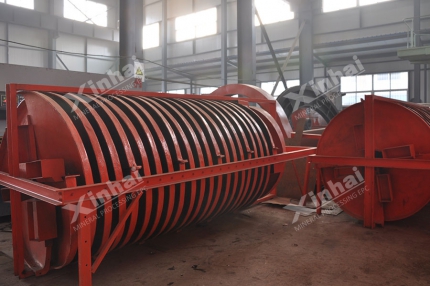
Coarse wolframite → gravity first (jigs, tables, spirals)
Fine scheelite → flotation (rougher + cleaner, Petrov if calcium gangue is high)
Slimes → separate circuit (centrifugal concentrators, high-gradient magnetic separation, sometimes flotation with chelating collectors like benzohydroxamic acid)
Bulk rough concentrate → magnetic split: wolframite is weakly magnetic, scheelite isn't. Separate them physically, then clean each on its own track.
By-products: float sulphides first (Cu, Pb, Zn, Bi, Mo, S), recover cassiterite by magnetic/electrostatic/gravity methods, and if fluorite grades are decent, float it from the tailings. Every by-product you recover is a hedge when tungsten prices dip.
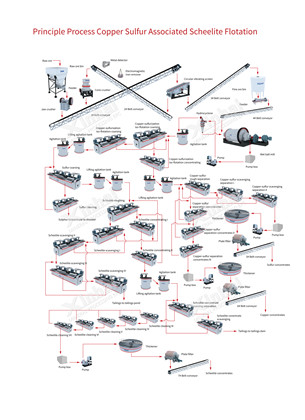
There's a well-known approach from complex deposits in China — bulk mixed flotation of wolframite and scheelite together using chelating collectors, then splitting them downstream with heating and magnetic separation. It works, but it's not a universal template. Your ore is its own beast. Test it.
At Xinhai, this is where combined process design becomes important. A mixed tungsten ore may require several separation methods within the same flowsheet rather than relying on a single process. The objective is not to make every ore fit one standard circuit, but to match each separation stage with the mineral characteristics it is designed to handle.
05Fine Tungsten: Why Does It Deserve Separate Attention?
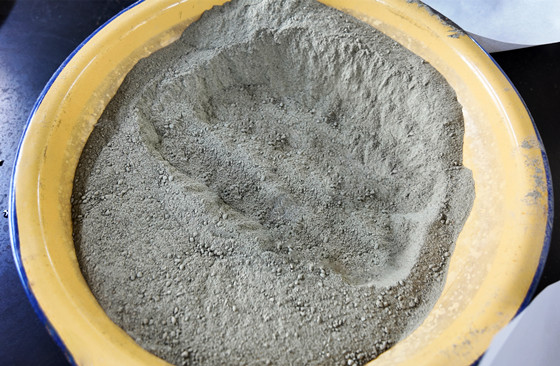
A large chunk of tungsten losses doesn't happen at final cleaning — it bleeds out in the fines. Tungsten minerals are brittle; grind fine enough for liberation, and you'll inevitably create slimes, where recovery drops sharply. That's the classic trade-off: under-grind, and you leave tungsten locked in gangue; over-grind, and you lose it to slimes.
Before upgrading a plant or evaluating tailings retreatment, answer these first:
Which size fraction loses the most? Size-by-size assay the tails.
What form is the lost tungsten in? Free fines, locked grains, or slimy coatings?
Under-liberation or over-grinding? Dictates whether you need coarser grinding or a circuit rethink.
What are the slime-surface properties? Determines whether flotation, magnetic, or gravity fine-recovery is the right call.
Are middlings cycling too long? Excessive recirculation re-grinds particles into unrecoverable slimes.
Once you've nailed these, equipment selection is easy. The machines exist — centrifugal concentrators, high-gradient magnetic separators, column flotation. The hard part is knowing exactly what you're catching, at what size, and in what form.
06Comprehensive Recovery of Associated Minerals: Do Not Focus Only on WO₃
Tungsten-only plants are vulnerable. When WO₃ prices drop, plants that also recover tin, copper, bismuth, molybdenum, or fluorite keep running. Those that don't, don't.
By-product | Method | Note |
Sulphides (Cu, Pb, Zn, Bi, Mo, S) | Flotation, sequential | Always float sulphides first — they interfere with tungsten circuits if left in |
Cassiterite (Sn) | Gravity, magnetic, electrostatic | Wolframite and cassiterite co-occur constantly; separate via magnetism |
Fluorite | Flotation from tungsten tails | Can be a meaningful credit if grades permit |
Molybdenum | Separate handling or rejection | High Mo in scheelite concentrate creates smelter penalties |
By-product recovery is also one of the areas where process design has to look beyond the tungsten concentrate alone. At Xinhai, the broader engineering approach is to evaluate the whole mineral assemblage and consider whether associated valuable minerals can be recovered within a practical flowsheet.
07What Really Matters in Tungsten Beneficiation?
For an actual tungsten project, the real challenge is usually not finding a piece of equipment that can work. It is connecting:
Ore Characteristics → Beneficiation Testwork → Flowsheet Design → Equipment Selection → Engineering Implementation
This is also the basic approach Xinhai Mining emphasizes in its mineral processing engineering practice:
Study the ore first. Then determine the flowsheet. Verify the performance through testwork before moving to engineering design.
For different types of tungsten ores, we do not simply apply a standard “wolframite flowsheet” or “scheelite flowsheet.” Instead, the process is developed according to the ore characteristics, mineral associations, liberation size, associated minerals, and product requirements.
From gravity and magnetic separation to flotation, and from single-mineral tungsten recovery to comprehensive recovery of multiple valuable minerals, the objective is not simply to add more equipment. Each separation stage should have a clear mineral-separation purpose.
That is one of the key differences between mineral processing engineering and equipment selection alone.
 marketing@xinhaimining.com
  0086 13810327080



 CHAT
CHAT MESSAGE