In a mineral processing plant, classification may not attract as much attention as crushing or grinding, but its impact extends throughout the circuit. A hydrocyclone separator determines the particle size distribution of material moving to downstream processes and directly affects the conditions under which subsequent separation takes place.
Unstable hydrocyclone performance allows coarse particles into the overflow and fine particles into the underflow. This reduces grinding circuit efficiency and undermines flotation, magnetic separation, and gravity concentration performance.
Use the table of contents below to navigate through the guide:
01How Do Xinhai Hydrocyclones Improve Classification Accuracy?
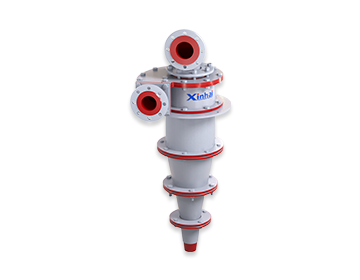
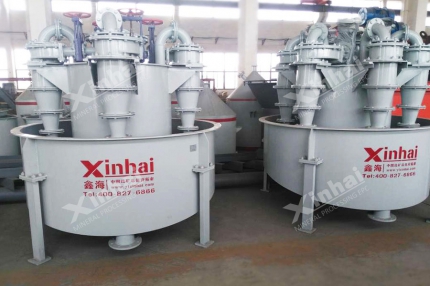
Xinhai developed its high-precision, wear-resistant hydrocyclones around three key requirements: classification accuracy, operating stability, and service life.
The design focuses on the areas that most directly affect long-term performance—from slurry entry and internal flow behavior to wear protection. By optimizing these elements, Xinhai addresses common challenges in mineral processing plants, including rapid wear, blockage, fluctuating classification performance, and frequent maintenance.
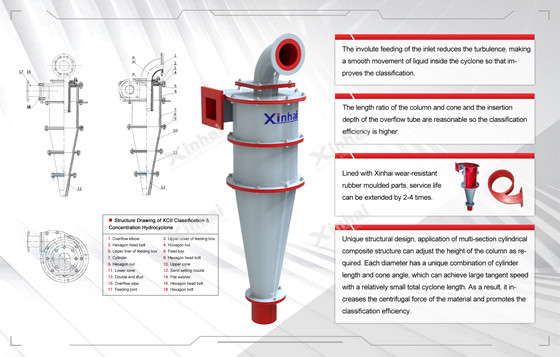
The result is a hydrocyclone designed to help concentrators maintain more stable operation and reduce the impact of classification issues on overall plant performance.
1. Involute Feed Design: Smoother Flow, More Accurate Classification, and Lower Wear
The way slurry enters a hydrocyclone has a direct influence on its internal flow field.
Conventional tangential feed designs can generate strong turbulence near the feed inlet. This can disrupt the stability of the centrifugal field, affect classification accuracy, and accelerate wear in the feed chamber.
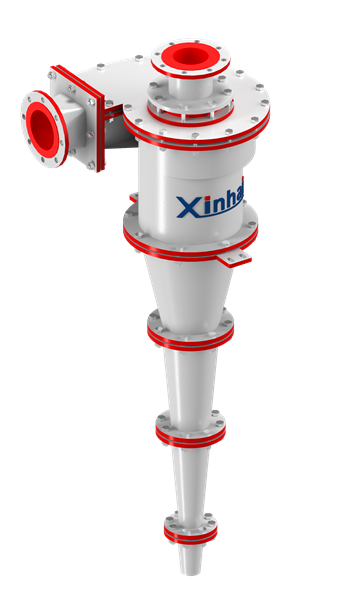
Xinhai hydrocyclones use an involute feed design to guide slurry into the cyclone more smoothly. The design reduces turbulence and helps create a more uniform centrifugal field inside the hydrocyclone.
This brings two practical benefits: improved classification accuracy and slower wear in the feed chamber. By reducing unnecessary turbulence and direct slurry impact, the design also helps minimize premature wear at the point where the slurry first enters the equipment.
2. Optimized Cylindrical-Conical Geometry and Vortex Finder: More Stable Flow and Higher Separation Efficiency
Hydrocyclone performance depends heavily on the relationship between its internal structural parameters. The proportions of the cylindrical and conical sections, together with the vortex finder design, directly influence slurry flow behavior and separation efficiency.
Xinhai optimizes the cylindrical-conical geometry and vortex finder design based on extensive field data and fluid-flow simulations. These improvements promote smoother slurry movement inside the hydrocyclone while helping control short-circuit flow and unwanted particle mixing.
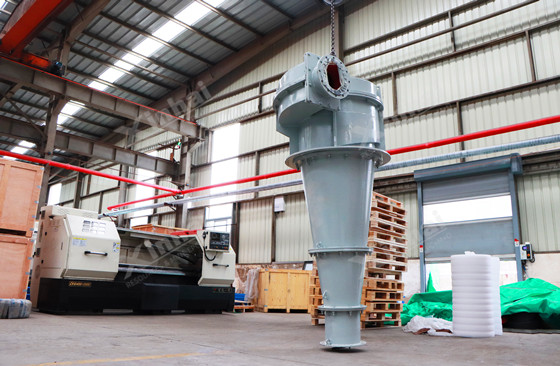
As a result, the hydrocyclone can achieve higher separation efficiency and more stable classification performance, creating more consistent feed conditions for downstream beneficiation processes.
For concentrators, this stability can be just as important as classification efficiency itself. A stable classification circuit helps downstream equipment operate under more consistent conditions and supports more reliable overall plant performance.
3. High Wear-Resistant Rubber Liners: Less Wear and Less Downtime
Wear is one of the most persistent challenges in hydrocyclone operation.
Hydrocyclones continuously handle high-concentration slurry, often containing hard and abrasive particles. Under these conditions, conventional lining materials can wear quickly and require frequent replacement. This increases spare parts consumption and maintenance workloads while creating additional risks to production continuity.
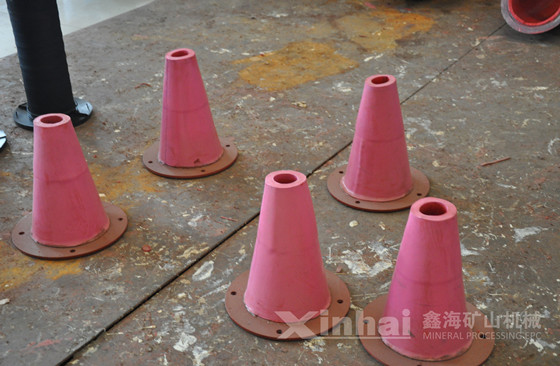
Xinhai uses high wear-resistant rubber liners in its hydrocyclones. This rubber-lined hydrocyclone design combines abrasion resistance, impact resistance, and corrosion resistance to improve equipment service life in applications involving high-concentration and highly abrasive slurry.
Under suitable operating conditions, the service life of relevant wear-resistant components can be approximately 2–4 times longer than that of conventional structures. Actual service life depends on ore hardness, slurry concentration, feed pressure, particle size distribution, and operating conditions.
For plant operators, longer wear life delivers a clear operational benefit: fewer shutdowns for component replacement, lower maintenance frequency, and more stable production continuity.
This advantage becomes particularly important in large-scale mineral processing plants, where even a relatively short shutdown can affect the performance and continuity of the wider grinding and classification circuit.
02How to Select a Hydrocyclone Based on Throughput and Target Classification Size?
Selecting a hydrocyclone is not simply a matter of comparing equipment prices or choosing a unit based on one technical parameter.
A suitable hydrocyclone must match the actual conditions of the processing circuit. In a typical ball mill hydrocyclone circuit, the hydrocyclone also needs to work effectively with the existing grinding system. Key factors include:
Xinhai can support hydrocyclone selection based on ore characteristics, processing capacity, feed particle size, slurry concentration, and target classification size. Based on these conditions, the technical team can recommend an appropriate equipment configuration for the project.
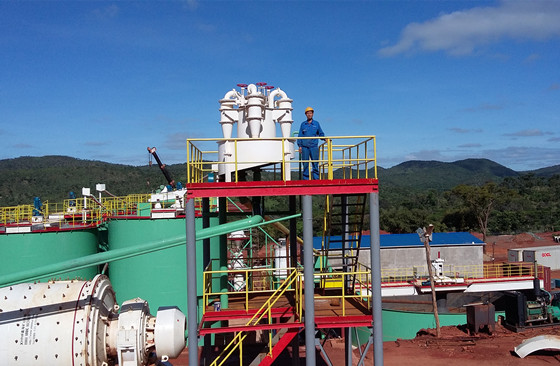
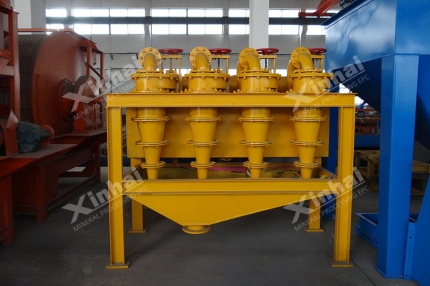
Whether a project requires a single hydrocyclone or a hydrocyclone cluster for a large-scale mineral processing plant, Xinhai can configure and customize the system according to actual project requirements. Where higher throughput requires multiple hydrocyclones operating in parallel, the equipment can also be configured as a hydrocyclone bank.
03Xinhai Hydrocyclone and Hydrocyclone Cluster Solutions
Classification performance depends on more than the hydrocyclone itself. Equipment selection must also match the ore characteristics, process requirements, and operating conditions of the grinding circuit.
If your operation is experiencing unstable classification, rapid hydrocyclone wear, frequent shutdowns for component replacement, or difficulties in hydrocyclone selection, Xinhai Mining Group can provide technical support for equipment selection and classification system evaluation.
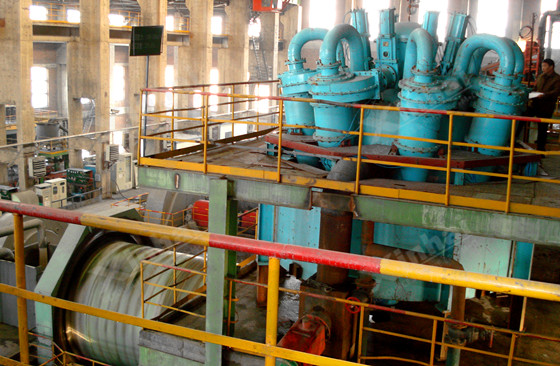
To support a more targeted assessment, please provide the following information:
Ore characteristics and hardness
Required processing capacity (t/h)
Target classification size (mesh/μm)
Existing grinding circuit and equipment configuration
With this information, Xinhai's technical team can evaluate the application conditions and assist in developing a hydrocyclone selection and configuration solution suited to your project.
 marketing@xinhaimining.com
  0086 13810327080







 CHAT
CHAT MESSAGE